Translate:
Landscaping
IMPORTANT Devonshire Lawn Care Update
Devonshire is currently experiencing a widespread turf problem consistent with Take-All Root Rot (TARR), a fungal disease that attacks the root system of St. Augustine grass and can result in large areas of thinning or dead turf.
Unlike more common lawn diseases such as Brown Patch and Dollar Spot, TARR requires a specialized treatment and recovery program beyond our normal lawn-maintenance services.
How Is Your HOA Addressing This Issue?
The Devonshire Board is working closely with our lawn-care service provider, DORA Landscape, on a multi-phase treatment and recovery program designed to control the disease, protect surviving turf, encourage root recovery, and reduce further damage.
The first phase consists of three specialized fungicide treatments approximately 30 days apart:
- October 2026 – Azoxystrobin
- November 2026 – Propiconazole
- December 2026 – Atticus Artavia XCEL
DORA's discounted cost for these three (3) community-wide treatments is $12,150.
A second identical three-treatment cycle is also planned for early spring 2027 as part of the overall recovery program, bringing the total discounted cost of the six (6) fungicide applications to $24,300. Because TARR attacks the roots, residents should not expect an immediate visible improvement after the initial treatments. The first objective is to control the disease and improve the health of the root system.
How Will the $24,300 Treatment Program Be Funded?
The Board plans to fund the entire $24,300 treatment program through the 2027 budget rather than charging homeowners a separate special assessment for the treatment.
To help offset the majority of this expense, the proposed 2027 budget eliminates approximately:
- $9,300 in community mulching
- $7,000 in front canopy tree pruning
The Board believes these services can be deferred for one year based on the community's recent mulching schedule and the current healthy condition of our front canopy trees.
The remaining cost of the TARR program, along with normal annual increases in community operating expenses such as management services, electricity, insurance, and other administrative costs, is included in a proposed $9-per-month increase in Devonshire's HOA assessments for 2027 (residents will be receiving a copy of the 2027 budget in the mail in the next week).
What Happens in the Spring?
After the initial fall/winter treatment cycle, DORA will evaluate the condition of the turf and identify areas that have suffered significant damage. Soil tissue samples will be taken to confirm if TARR is still present in order to determine if it's advisable for residents who wish to invest in replacement sod to move forward.
The Board recommends that homeowners wait for Dora's evaluation before replacing damaged sod. Installing new sod too early could result in homeowners investing in replacement turf before the underlying disease has been adequately mitigated.
Areas requiring replacement sod will be measured, and homeowners who choose to replace damaged turf will receive an individual estimate from DORA before authorizing the work.
DORA is offering Devonshire homeowners a special "Partnership Discounted Price" of approximately $2.25 per square foot for full sod remediation (which includes dead turf removal, area and soil prep with micronutrients, sod delivery, and professional installation).
Irrigation Is an Important Part of Recovery
Proper supplemental watering will also be critical. Residents should avoid both extremes: allowing turf to become severely drought-stressed and keeping the soil excessively wet or constantly saturated.
During hot or dry periods, once-a-week irrigation may not provide enough moisture. Supplemental watering may be necessary depending on the conditions.
Residents should also check their property for irrigation or drainage problems and submit a work order for areas experiencing significant or spreading turf decline so Dora can be formally notified.
Recovery Will Take Time
Please keep in mind that fungicide cannot bring already-dead grass back to life. The goal of the treatment program is to:
- Control the disease
- Protect surviving turf
- Encourage healthy root recovery
- Reduce additional turf loss
- Prepare damaged areas for successful sod replacement where necessary
Because TARR affects the root system, improvements may occur below ground before they become visible in the lawn.
DORA will continue monitoring turf conditions and coordinating the treatment, evaluation, sod-remediation, and recovery phases with Devonshire.
More Information
For residents who would like additional details about Take-All Root Rot, the treatment process, sod remediation, irrigation recommendations, and the complete recovery timeline:
VIEW THE COMPLETE TARR INFORMATION DOCUMENTS BELOW ATTACHED BELOW
If you have any questions or concerns, please do not reply to this email. Instead, reach out to one our board members or submit your question on our contacts web page link found here:
Devonshire Contacts
Thank you for your patience and cooperation as we work to restore the health of Devonshire's lawns.
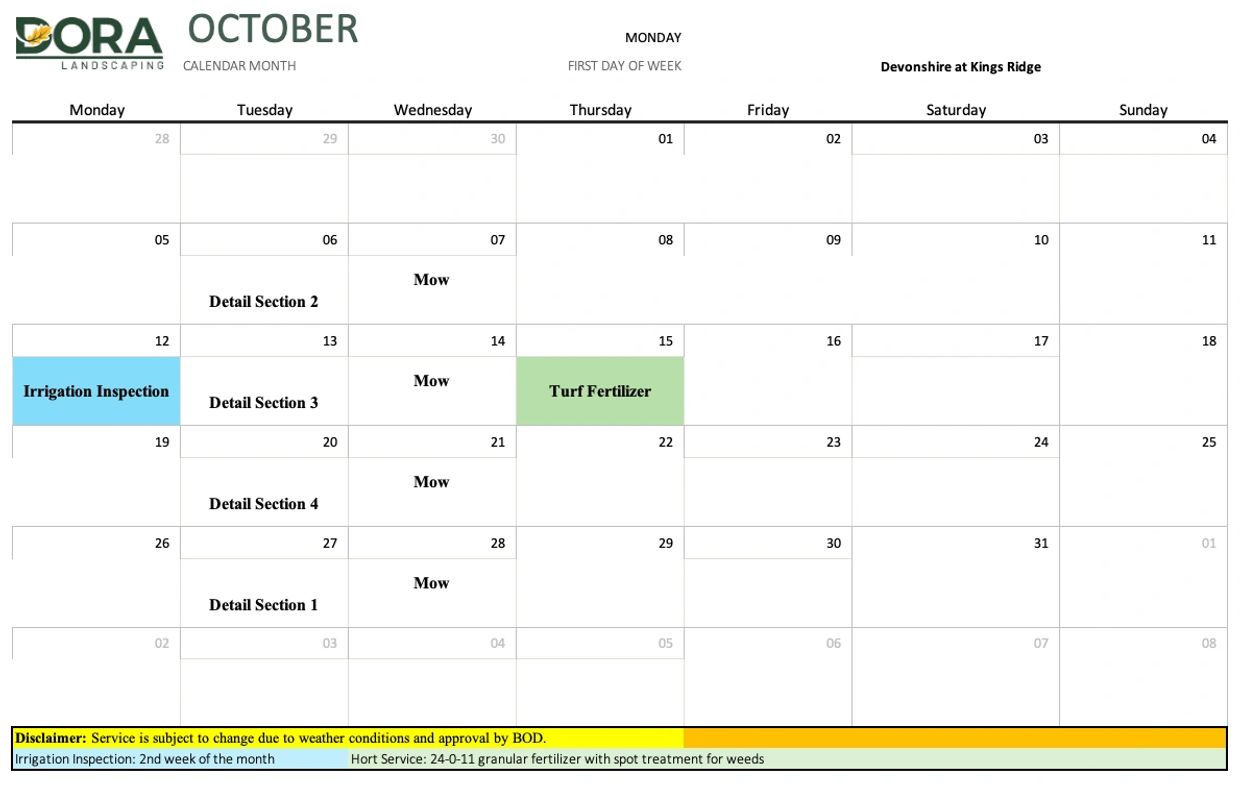
DORA / DEVONSHIRE WEEKLY Schedule
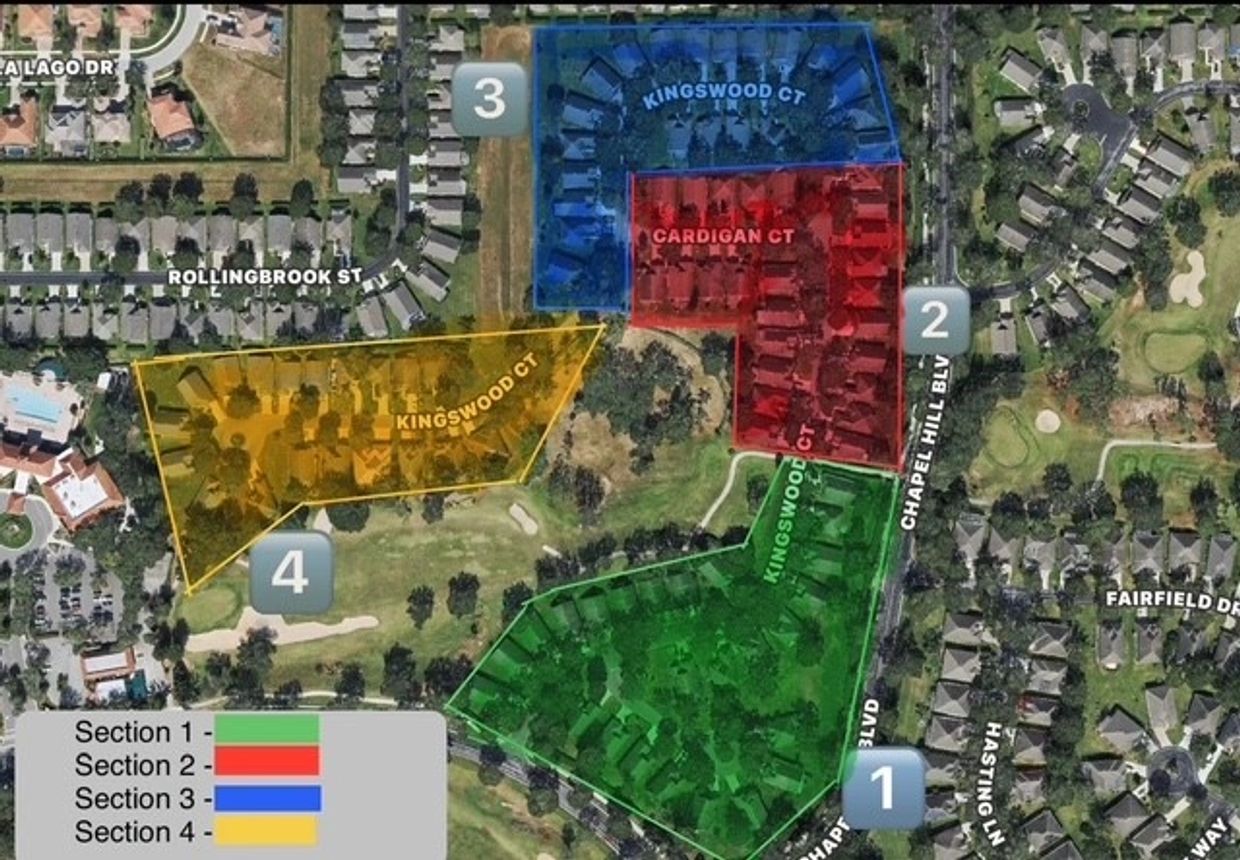
DORA / DEVONSHIRE WEEKLY DETAIL ZONE MAP
DORA Landscaping: FROST-DAMAGED PLANT REPLACEMENT PLAN NOTICE
On APRIL 1, 2026...our LAWNCARE contractor will be "DORA Landscaping". More forthcoming on this exciting development.
This email is to make you (as homeowners) aware of a FROST DAMAGE PLANT REPLACEMENT PLAN offered by DORA.
This linked document is for your review detailing the program.
All relevant program details are included in the attachment should you, as a homeowner, choose to engage "directly" with DORA for this service.
- IMPORTANT DISCLAIMER: DEVONSHIRE HOA does not officially endorse nor make any direct implied warranties in support of this program...this information (program) is being made available to DEVONSHIRE Homeowners directly from DORA Landscaping as an option for addressing plant damage on your property caused by the recent "hard freeze".
- QUESTIONS? Homeowners may contact DORA Landscaping directly at: 407-886-3103.
REPLACEMENT PROCESS:• A list of available plant material and cost per plant is provided for your review and selection.• A Frost Damage Plant Replacement Form (attached) will allow each homeowner to select the replacement work they would like completed.• Once all selections are received, DORA Landscaping will schedule the installations together as one coordinated project.• Completing the work as a larger group project allows us to offer bulk pricing, helping reduce overall costs for homeowners.• The attached Frost Damage Replacement form and payment must be completed and returned on April 1, 2026 between 10am-1pm at the clubhouse in order to be scheduled for installation in May 2026. A final installation schedule will be sent closer to the project start date.
- Payment is due at time of request.
IMPORTANT DISCLAIMER:• Material unit price INCLUDES DEMOLITION, HAULING, AND DISPOSAL OF REMOVED MATERIAL.• No warranty will be provided on installed plant material or sod.• It is the homeowner’s responsibility to provide supplemental hand watering in addition to scheduled irrigation run times.• Any plants not on the attached list will be priced separately as a “Specialty Item”• This program is limited to plant-for-plant replacements only. Any deviation will require a separate proposal. EX: A damaged Liriope will only be replaced with a new Liriope.
At Your Service,
Devonshire Board
CURRENT DROUGHT CONDITIONS / Effect on Residential Turf Grass
Please refer to the letter from Down To Earth regarding drought conditions directly below this section
Many of you have shared your recent frustration (by logging work orders) at seeing increasing brown / dry / dead spots developing in your St Augustine lawns believing there is an issue with irrigation or some type of insect infestation. The lawn stress areas you’re seeing are primarily due to a simple lack of water…not because the system isn’t operating correctly or because of chinch bugs or grub worms.
It’s important to understand, our irrigation system is centrally controlled and that DOWN TO EARTH has ZERO control on how many days a week we receive irrigation and for how long each irrigation cycle lasts.
Currently, we are scheduled to receive irrigation cycles 2X a week (Monday and Thursday) for a max 15-19 mins (contingent upon a number of factors like water table levels, moisture measured in the soil, and rainfall). DVI (the company who oversees and manages the overall Kings Ridge irrigation system infrastructure)…commented in a recent meeting…they are under constant pressure by the county to conserve water by limiting irrigation cycle-times.
It’s also important to understand St Augustine turf grass is not drought tolerant. It requires regular deep watering (at least 20-30 mins 2-3X a week in hot weather) to maintain a healthy green appearance. Therefore, supplemental watering by the homeowner is recommended.
Another challenge is being adjacent to the golf course where Bermuda grass is resident…Bermuda (which is more drought tolerant than St Augustine) quickly spreads in hot dry conditions and will naturally creep in and take hold in a St Augustine lawn…especially when the St Augustine turf grass is starting to stress and begins thinning…ultimately choking the St Augustine out and taking over.
Weed herbicides DO NOT work to clear out Bermuda…because both Bermuda and St Augustine are “grasses”…these grasses don’t coexist very well…because to maintain Bermuda…it needs to be mowed at around 1-2” tall (see the golf course fairways and rough areas). St Augustine on the other hand is maintained / mowed between 4-5” tall…so when our St Augustine lawns are mowed at this higher height…the underlying Bermuda that’s found it’s way in…grows taller as it quickly spreads looking unkempt and “wispy”…it’s a completely different texture of turf grass…there are many lawns throughout Kings Ridge with increasingly large patches of Bermuda grass.
While there is a new product that “claims” to kill Bermuda but not St Augustine (which DTE is going to start to use)…there is no guarantee it will effectively or fully rid lawns of Bermuda grass…the only effective way to fully get rid of Bermuda in your lawn is to kill it…spray it with a grass killer (while it’s actively growing during hot weather because it has a very deep taproot)…once dead…the area / dead material can then be raked out…the area should be prepared by adding topsoil and then new St Augustine sod installed and thoroughly watered in until it takes root. This mitigation effort (while effective) would be at the homeowner’s expense.
I trust this information is helpful in understanding the challenge we all face with increasing irrigation water restrictions being placed on all communities throughout central Florida.
Devonshire Board
Down to Earth letter regarding drought (pdf)
DownloadNEED For Supplemental Lawn Watering
DEVONSHIRE RESIDENTS
With increasing temperatures comes greater stress on our “St Augustine” lawns.
Our irrigation system is programmed to run 2x a week for a maximum 15-19 mins (at best). Many factors impact irrigation days and the amount of time water is delivered such as water table levels, previous rain, drought (where water restriction is enacted), etc. We as a community (nor Down To Earth) have “NO” control on the amount of water delivered via irrigation.
Like all lawn turf, St Augustine requires adequate water to remain healthy and green.
When not enough water is being delivered “HOT SPOTS” (browning dying areas) can result. With the warmer weather, HOT SPOTS are starting to show up intermittently around Devonshire. Lawn areas where the soil has depleted over the years…becoming more sandy are most suceptable…adding some compost to these areas can help…but “SUPPLEMENTAL WATERING” is recommended.
Hand watering – especially hot spots – can help reduce drought damage. Spritzing a lawn during the heat of the day will cool down the lawn and add humidity. Soaking hot spots will bring life back to withered dying grass. Note: Watering during the day does not damage your lawn – it helps your lawn.
Trust this is helpful.
Brack Leaberry
Devonshire Board Member
Lawncare Liason
Spectrum Cable/Internet
Spectrum TV Channel Lineup and Enhancements
SPECTRUM TV
ENHANCEMENTS
Streaming services available to Devonshire residents at no additional cost:
Disney/Hulu Bundle
HBO Max basic with ads
Paramount Plus Essential
Peacock Premium
ESPN Unlimited
Fox One
MAX
VIX
TENNIS
These services are available to you on your “smart” TV, ROKU, Fire Stick, Chromecast and other streaming devices.
Rev. 09/14/26
Devonshire Channel lineup (pdf)
DownloadHouse Painting
List of Current House Color Codes
Recycling
Just a short reminder of items that go into our Recycling Containers
Recycle Items (pdf)
Download